Do you know? The coffee trade, which accounts for the largest share of tropical beverages such as coffee, cocoa and tea, has grown the fastest since 2000.
Coffee culture is developing rapidly in the world, and the consumption of coffee is expanding in import and export countries. Coffee is one of the world's most widely consumed beverages and one of the world's most traded commodities. The biggest coffee producers are Brazil, Vietnam and Colombia, while the European Union and the US are the world's biggest consumer and import markets. Coffee is a growing market, partly due to increased consumption in emerging economies and strong interest in boutique coffee and product innovation in developed countries. So innovation and new technologies are essential for the industry to become more productive and competitive in the beverage industry.
Our company recently produced a coffee bean grader according to customer requirements, which consists of a belt conveyor and a drum sorter. Coffee bean grader is low cost, accurate classification, and small footprint.
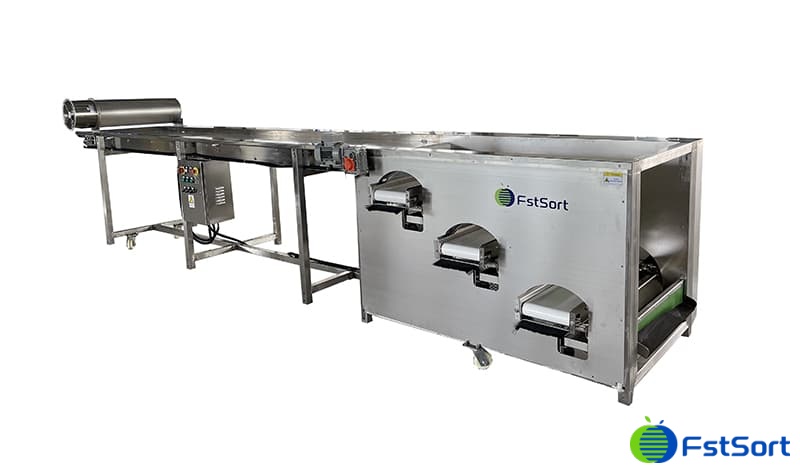
So what does the size of the bean have to do with the quality of the coffee? On the one hand, the uneven size of beans indicates rough grading, while a large difference indicates raw beans are not premium grade. Green coffee beans, on the other hand, need to be graded according to size, mainly for coffee roasting. The price of each grade of coffee varies, and the requirements for grinding vary.
As far as roasting is concerned, the smaller the difference in grain size of beans, the better the roasted coffee will be, and the coffee will taste better after roasting. Coffees that are usually of the same size and nearly the same density can easily be roasted together to achieve the desired optimum condition. Also, larger beans from the same batch tend to have a better flavor than smaller or less grown coffee. Since larger beans tend to be better quality, more eye-catching, and more sought after by coffee lovers, sizes of beans are usually indicated on a 10-20 scale, but this is not always the case. In other words, coffee beans are not absolutely bigger is better. There are also classified according to the level, such as A, AA, etc.
Although size is not the standard for judging the quality of coffee beans, it is important to ensure that the whole batch of beans of the same variety are uniformly sized so that they can have the same growth cycle, taste and price. If there are too many different sizes in the same batch of coffee beans, they will have a larger difference in taste. Of course, the quality of a coffee bean depends on many factors, not only the size of the bean, but also the place where it is produced and its shape and taste.
For more details on our range of coffee bean equipment, please click here.